
The Falling Man
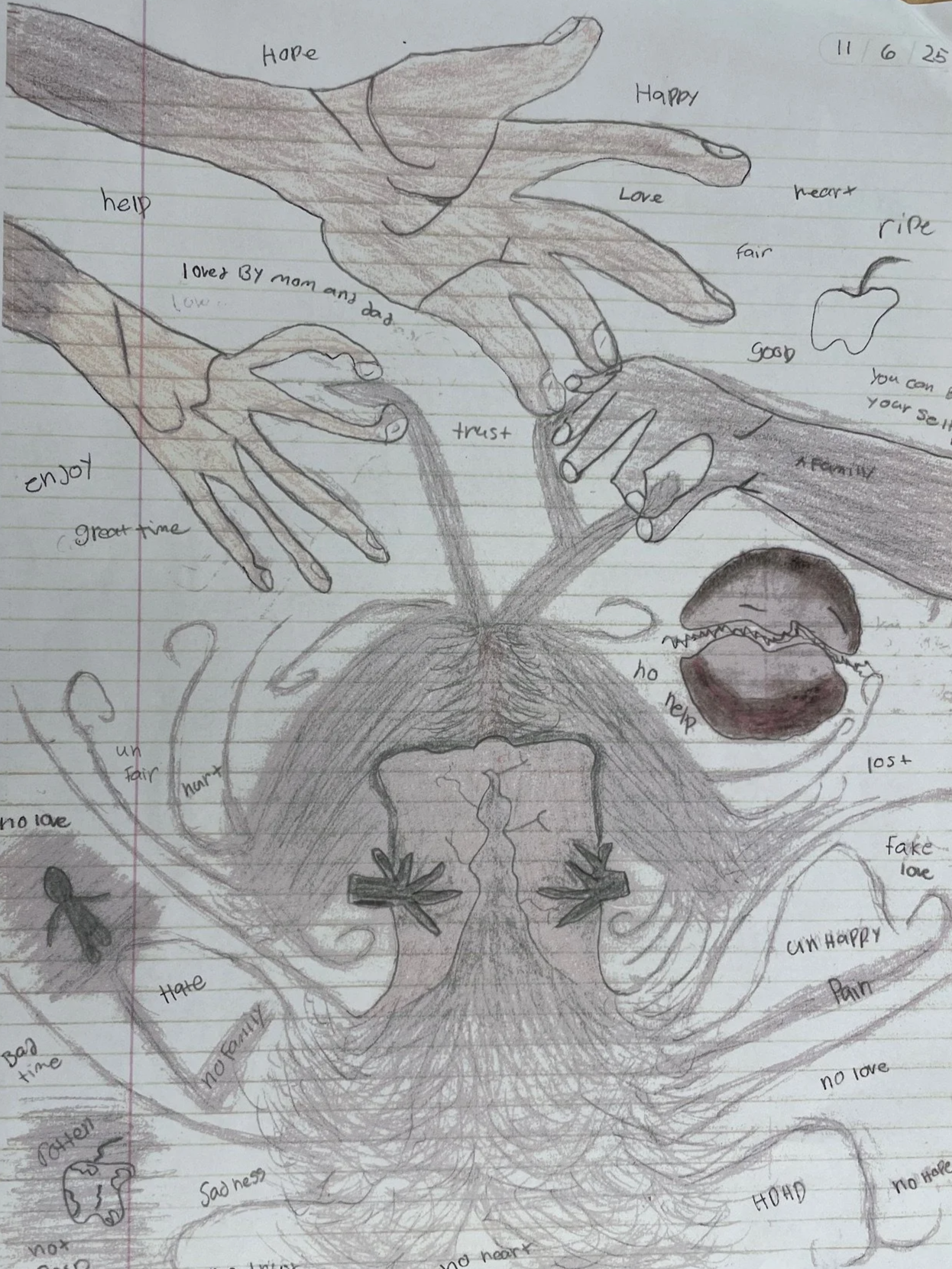
Untitled | Jay Fields | Colored pencil
The Falling Man by Ashley Argueta Urquilla
A man falls through a blue September sky, with his body perfectly vertical, with no blood in the frame, no fire touching his shoes, no scream coming from his mouth. We call it history. We call it tragic. We call it art. But we do not call it unbearable. The stillness of this image feels unreal, especially when it’s placed against the chaos of the morning it came from. This frozen moment becomes easier to look at when it is separated from the smoke, the heat, and the screams that replaced the air that day. Where sanitization becomes our version of heroic, and reality becomes controversial.
At 9:14:15 am, there were captures of sequential shots, but famously a frozen, unknown man seeking safety, which was later deemed to be disturbing to American Newspapers. Within hours, images like this were quietly removed from front pages, replaced by photographers standing tall and survivors wrapped in flags. He was one of the many people trapped above the floors, where the heat climbed past survivable limits, and smoke became a suffocating substitute for oxygen. The jump was not an act of escape; it was an act of urgency in a world that was suddenly stripped of control. The choice was never life or death; it was between fire and air. It was between one terror and another. This is the falling man.
On the morning of September 11, 2001, the world watched the Twin Towers burn. We watched fire eat through the floors. We watched it on live television. The suspense increased with each passing moment. But some things, we were not meant to watch, yet Richard Drew’s camera did, as he later said, “I didn’t take the picture. The camera took a picture of the falling man.” This is the falling man.
The photographer is no stranger to history. Richard Drew saw it essential to show the reality of the event, comparing it to other images he had taken, such as Bobby Kennedy being shot, Muhammad Ali, and more. When taking the shot of the falling man, Drew states, “I didn’t capture this person’s death. I captured part of his life. This is what he decided to do, and I think I preserved that.” The photograph does not dramatize his fall; it does not explain him. Instead, it leaves the audience alone with the fact that this was a human making an impossible choice. He is not introduced nor known by his name; he is not framed as a hero; he is merely a man. A man who had lived, who worked, who had somewhere to be that morning. And now he exists in the stories we tell and stories we refuse to tell. Stories that were removed the evening of the tragedy from national coverage.
History was caught, and the violent truth was revealed. Then, almost immediately, it was rejected. Exploitative. They said. Violation of privacy. They said. Stripped of his dignity. They said. The people wanted heroism. Yet the images that remained, like firefighters climbing upward, survivors being pulled, were easier to accept because they offered strength instead of helplessness. They wanted suffering without the rawness of the situation. They did not want a man who chose to fall. This is the falling man.
We accept the images that comfort us; we avoid images that scare us. We preserve images that reassure us; we bury the images that force us to confront reality. Society does not record tragedies; it edits them. Sanitized images offer us tragedy with no responsibility. And still, we look away. Because if we look too long, we must admit that suffering is not always heroic, but simply human. This is the falling man.
The falling man stays in the archives of memories because he carries the part of 9/11 we struggle most to face, vulnerability. He exists at the moment when fear took over, when people fled the streets of New York, when strangers became suspects, when brown skin and foreign accents were suddenly treated as threats. In the days that followed, grief hardened into suspicion, and vulnerability was redirected into anger and blame. The falling man reveals humanity unwrapped from heroism. He reminded us of fear before it demanded answers or someone to blame. Yet, the choice of what we accept, what we avoid, what we are willing to witness and talk about, becomes the most revealing image of all. This is the falling man.