
Before the Red Touched the Ground
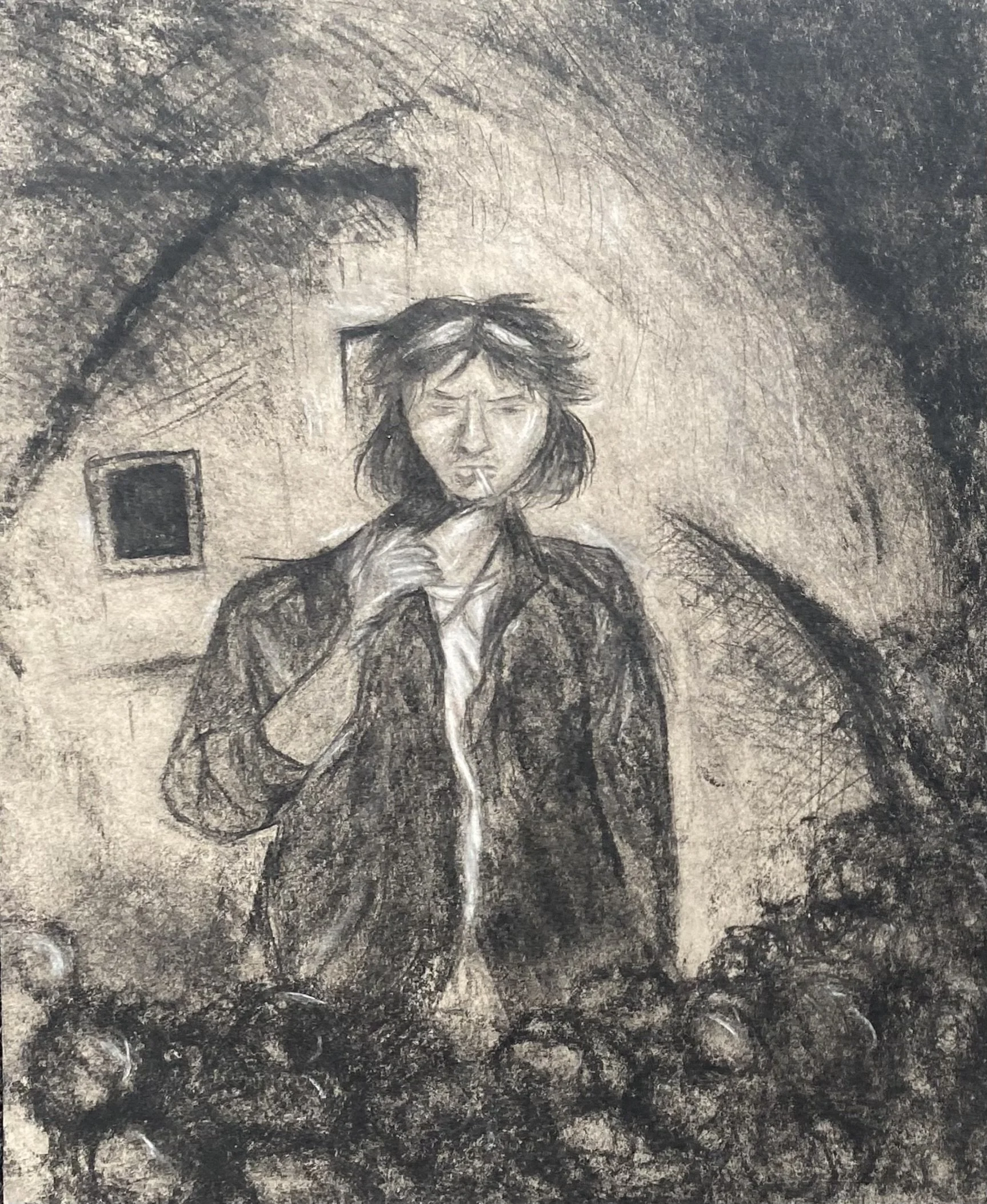
Untitled | Maya Surak | Charcoal
Before the Red Touched the Ground By Eden Tenagashaw
In the grainy black and white photograph, Mengistu Haile-Mariam stands above the world on a narrow metal platform, high enough that the sky has become his backdrop. His uniform is sharp, almost glowing against the washed out background, the short sleeves pulled tight across his shoulders as if even the fabric obeys him.
One arm stretches upward, fist warped around a dark glass bottle held up high like a torch and a hammer fused together, promising light, promising work, promising a new beginning. Below his hands, microphones cluster at the edge of the stage, thin necks craning towards his mouth, ready to carry whatever flames fall from his voice. His head is tilted back, mouth open in a shout we cannot hear, but his expression is all confidence and intensity and triumph. The sharp tilt of his chest, the set of his jaw, the way he leans into the empty space before him: he looks like a commander claiming victory, an actor in a perfectly staged melodrama, a man who owns the air around him.
Outside the frame, before this moment froze into ink and history, we were the ones beneath him, young, hopeful. Certain ideas could remake a nation. We crowded around cafe tables and campus steps with notebooks under our arms, newspapers spread between half empty cups, arguing over every headline and theory we could get our hands on. Ink stained our thumbs, voices overlapped, chairs scraped tile, the sound of thinking was everywhere. We believed land should belong to the farmer, that equality was possible, that a country could change if its children dared to imagine it differently.
When the old order finally collapsed, the air felt lighter, like doors opening after a long and heavy night. Soldiers stood beside us then, fist and mind together, and for a moment, it seemed enough. We looked up at the man on that metal platform, bottle raised like a promise, and believed he would carry our ideas forward. For a moment, the future felt real.
But promises are fragile things, easier to make than to keep. After the cheering faded and the ink dried on our notebooks, murmurs began to slip between conversations like a cold wind under a door. We still gathered, coffee warm in our hands, newspaper folded soft at the edges, but some headlines made us pause a little longer. People were taken, nights at first, then in daylight, hands pulled behind backs, uniforms steering them toward waiting trucks. Some returned weeks later, their eyes hollowed, voices quieter, as if part of them had been left behind on a distant floor where screams echoed. Others never returned at all. And on that platform, the bottle glinted differently in the sun, less like a torch now, more like something heavy, something unspoken. We kept believing, of course we did; youths always believed a little longer than they should. Yet there was a moment, small as a held breath, when we felt the future hesitate.
And then, everything snapped.
He raised the bottle again, arm high like in the photograph, and for one last second we still believed it was a torch, a symbol, a promise. But the air changed, a tight, electric silence, and when he slammed the bottle against the platform, the sound cracked through the crowd like a bone. Glass exploded, scattering like teeth across the dark asphalt, and red dye poured out in a sudden rush, pooling, spreading, running, too bright, too thick, too much like blood. He spoke, not of freedom, not of future, but of enemies. Of us. Of thinkers. He declared the students traitors, their blood the price of progress. The mind is a threat to power. In that instant, the torch in the image was never at all, only a bell for burial.
Uniforms turned. Newspapers vanished. Libraries emptied. Reading became rebellion, questioning became danger, and silence became a shield. Desks sat ghoststill. Notebooks waited open for hands that would never return. Mothers waited at prison gates with bread cooling in their palms. Some children came home different, eyes dimmed, voices shallow, spirit broken. Some did not come home at all. They, the ones in uniform, demanded payment for the “wasted” bullets used to kill our brightest, mothers buying death twice: once in blood, once in cash. Streets that once carried hope and resistance now carried bodies, and the revolution we birthed began to feed on us. They said “the revolution ate her children”, and the photograph proves the exact moment she opened her mouth.
History remembers the roar of revolutions, but it forgets how quietly the mind dies. We thought ideas were invincible, that knowledge could not be handcuffed, that thought would outlive force, but the photograph proved power can choke a future faster than time. A revolution begins in the mind, but it cannot survive on fists alone. Ideas must be protected. Thinkers must be protected. Because when power grows frightened of thought, it does not argue, it silences. It tortures. It buries potential before it blooms. We lost more than bodies those years; we lost the architects of tomorrow, the pages unwritten, the questions unanswered, the future that might have been. And once the mind learns to fear itself, dictatorship no longer needs chains, silence becomes its greatest weapon.
We still look at the photograph and see a man with his fist raised high, bottle lifted like a promise, but now we know better. We know how thin hope can be when power stands too tall, how quickly a torch of light becomes a bell for burial. If we do not guard the minds that imagine better worlds, if we trade thinking for loyalty and questions for silence, we will stand in this picture again, in another place, another decade, another crowd that believes it is safe until it isn’t. The past is not distant. It waits. It repeats. And revolutions will rise and crumble and rise again unless we learn to shelter the people who think, who question, who dare to carry ideas like light. Everything begins in the mind, and everything can end there, too. Never again should we watch a revolution eat her children.